


Rajesh Goli

Rajesh Goli

I run end-to-end engineering and science teams
built entirely on AI agents.

Former Amazon AGI. Now running AI agent teams that build the app, generate the data, train the models, interpret the results, and feed it all back — a recursive loop that improves itself. The tools below? I built those because I had to.

Session Manager app icon

The instruments for running
an engineering org of agents.

I run Claude, Codex and local-model agents as one engineering team, often seven sprints at a time. Session Manager does the orchestrating without spending a token and leaves me the decisions only I can make. Agents wrote all of it: 1,186 merged pull requests, and I haven’t written a line.

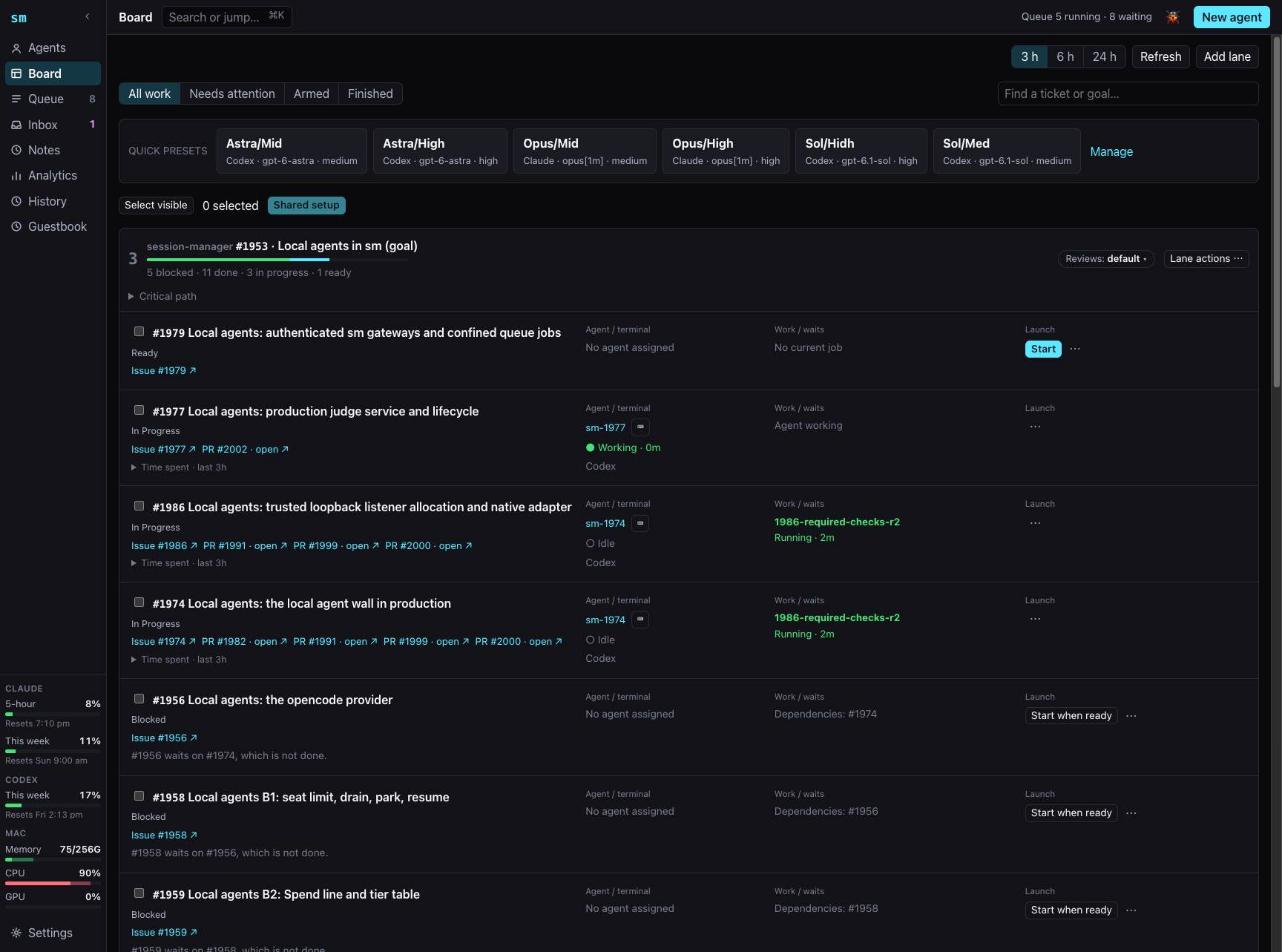
The Session Manager board: a goal broken into tickets, each with its agent, its status, and what it is waiting on
The board. Every ticket, its agent, and where the time is going: working, waiting on the queue, or waiting on me.

Plans solid before work starts

I comment inline on the plan; sm posts it to GitHub and wakes the agent. 156 plans in four weeks, about five rounds each.

Always knowing where time goes

A slow ticket can’t hide. Bottlenecks show themselves and get fixed.

Agents never trip over each other

One queue shares the dev box: 17,004 jobs since June.

The machine stays up

A memory guard catches one agent’s runaway job before it takes down the rest.

Only real asks reach me

An inbox for the decisions only I can make, on web or phone.

Nothing dropped between agents

Handoffs are readable, so agents catch each other’s gaps, and so can I.

Models talk to each other

Claude, Codex and local models message each other, or me, with one command.

Agents can afford to forget

sm sends 91% of the messages they receive: what they owe, right then.

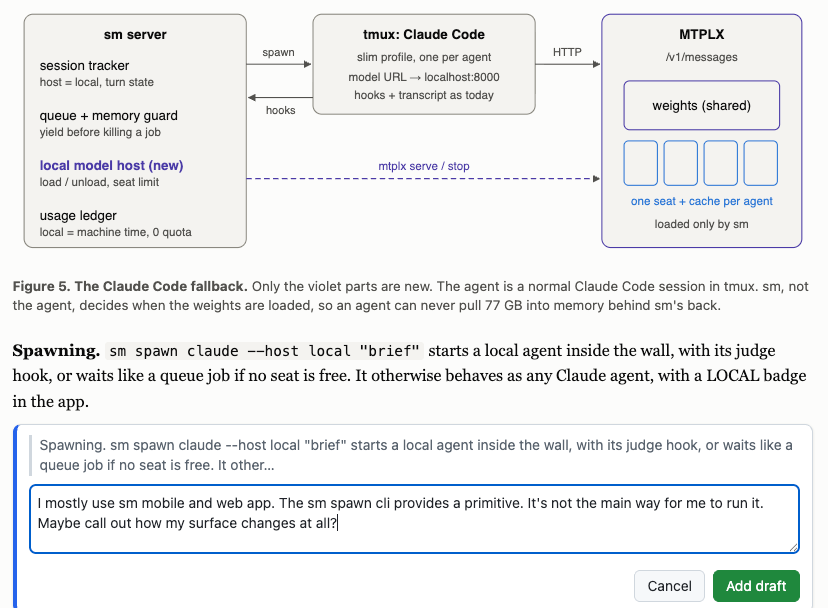
Reviewing a plan in Session Manager: a comment typed directly into the document
Reviews happen in the doc itself.
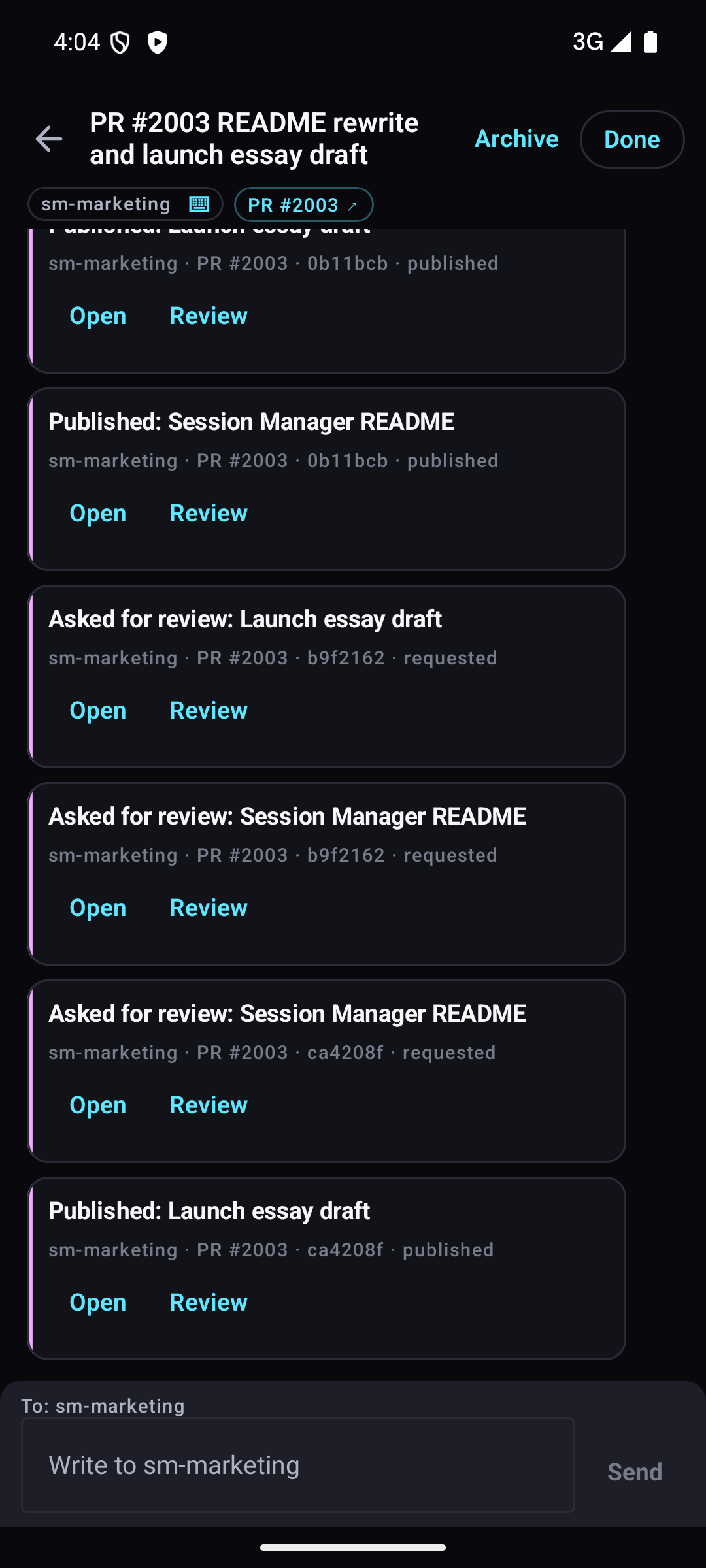
The Session Manager inbox on a phone
The inbox, on my phone.
DeskBar app icon

macOS shows apps.
You work in windows.

macOS's Dock tells you Safari is running — not which of three Safari windows holds the GitHub PR. DeskBar replaces it with a real Windows-style taskbar: one button per window, Option+Tab that cycles windows LRU (not apps) with live thumbnails, a built-in system resource widget, a keyboard launcher, and a native plugin system — including live session-manager integration. A productivity powerhouse for macOS, with no more flow-breaking trips to Mission Control.

macOS Dock
C
S
V
F

“Safari is open.”

But which of three windows? How many sessions of Claude? Can't tell.

→ Cmd+Tab. Mission Control. Click around. Flow broken.

DeskBar
C Spec for #2644 — session-manager
C PR #2646 review
S GitHub — rajeshgoli/deskbar
S ScreenCaptureKit docs
V TaskbarPanel.swift
F Finder — Projects (min)

Every window. Named. One click away.

PR #2646 · live preview
S
V
C
C Spec #2644
C PR #2646
S GitHub
V auth.py
MEM
11/18G
CPU
38%
sm
em eng rev
☀ ⏻ 9:41
launcher · pinned + kbd one button per window system widget · plugins tray
⌥ + Tab cycle windows — LRU, not apps
C PR #2646 review
S GitHub
V auth.py
C Spec #2644

Hold Option, tap Tab to advance, release to switch. Browsers, terminals, editors — jump directly to the window you actually want.

One button per window Option+Tab — windows, not apps Live thumbnails (ScreenCaptureKit) MEM / CPU / GPU widget Plugins — incl. session-manager Multi-monitor Pure Swift/AppKit, zero deps
View on GitHub →
Office Automate icon

Two questions.
One signal.

Two questions every workday: is the air I'm breathing any good, and did I actually work? Office Automate answers both from a single signal — the presence state machine that decides ERV speed is the same one that decides whether a git commit counted as office time. Runs on a Mac Mini in the office. No Kubernetes, no Home Assistant. Three Launch Agents and a SQLite file.

Office Mini · Live PRESENT · 4h 12m in seat
721 ppm CO2
72.4 °F
48 % humidity
0.32 ppm tVOC
5 μg/m³ PM2.5
41 dB noise
ERV Auto · quiet
HVAC Eco heat · 71°F
Door Closed · 4h 18m
This week · project leverage 28h 12m verified in seat
session-manager 34 commits 142 Claude · 87 Codex
deskbar 18 commits 23 Claude
office-automate 12 commits 18 Claude · 12 Codex
rajeshgo.li 9 commits 5 reviews
sm dispatches · 412 engram folds · 23 handoffs · 38

Sensors

Door / window Motion Mac activity CO2 / tVOC
→

State machine

PRESENT / AWAY door-open mode settle windows
→

Outputs

ERV + HVAC control Productivity ledger

Same signal. Two jobs.

Single source of truth for both halves Hysteresis-tuned ERV control Per-project input ledger PWA dashboard · Google OAuth Mac Mini · Python + React + SQLite
View on GitHub →
0 contributions
0 public repos
0 messages / day
to AI agents

Other things I've built along the way.

Writing.

Essays, fiction, and analysis from the blog — spanning 2005 to present.

Loading posts…
All posts on the blog →

The backstory.

It started in 2003 — training a neural network to recognize faces on a Pentium, writing TCP/IP stacks on 8051 microcontrollers, building paint clones in raw DOS graphics. A computer science degree at BMS College of Engineering, then an MBA at IIM Bangalore.

At Alcatel-Lucent, I went from writing routing protocols to running technical support strategy for a 1,000-person IP division. Then co-founded a data visualization startup. When that didn't work out, I joined Microsoft as the founding PM for Azure Backup — built the vision from scratch, growth hacked it 10x in three years, landed as leader in Gartner's Magic Quadrant.

At AWS, I spent seven years across two roles — Principal PM and then Senior Manager — launching Honeycode, creating its pricing (approved by Andy Jassy), and eventually championing a GenAI product for knowledge workers that became Q-apps, with $100MM+ revenue potential. Four patents. 300+ customer interviews across 45 enterprise accounts. Then Amazon AGI — where I led the "memory pattern" processing 5 billion data items a week across 5 lines of business.

In March 2023, I wrote a memo on the disruption potential of generative AI. I argued that AI "workers" operating under human supervision was tractable in the near term, and that chat was the wrong modality — complex tasks need iterative, asynchronous architectures with built-in validation. I estimated five years. It happened in eighteen months.

In January 2026, I left to build independently. I now run end-to-end engineering and science teams built entirely on AI agents. They build the application, generate the data, train the models, run mechanical interpretation on the results, and feed everything back into the loop — recursively improving the whole system. Claude and Codex work as teammates: Claude writes specs, Codex reviews them. Codex writes code (0.3 fix rounds per ticket), Claude reviews it (catches architectural drift). The tools on this page? I built them because I needed them to run those teams.

"Using AI agents is an empirical science. I didn't design this workflow. I tried every combination, tracked the data, and this is where it converged."

Let's talk.

Building in AI agent infrastructure, multi-agent systems, or thinking about what AI-native organizations look like? I'd like to hear from you.